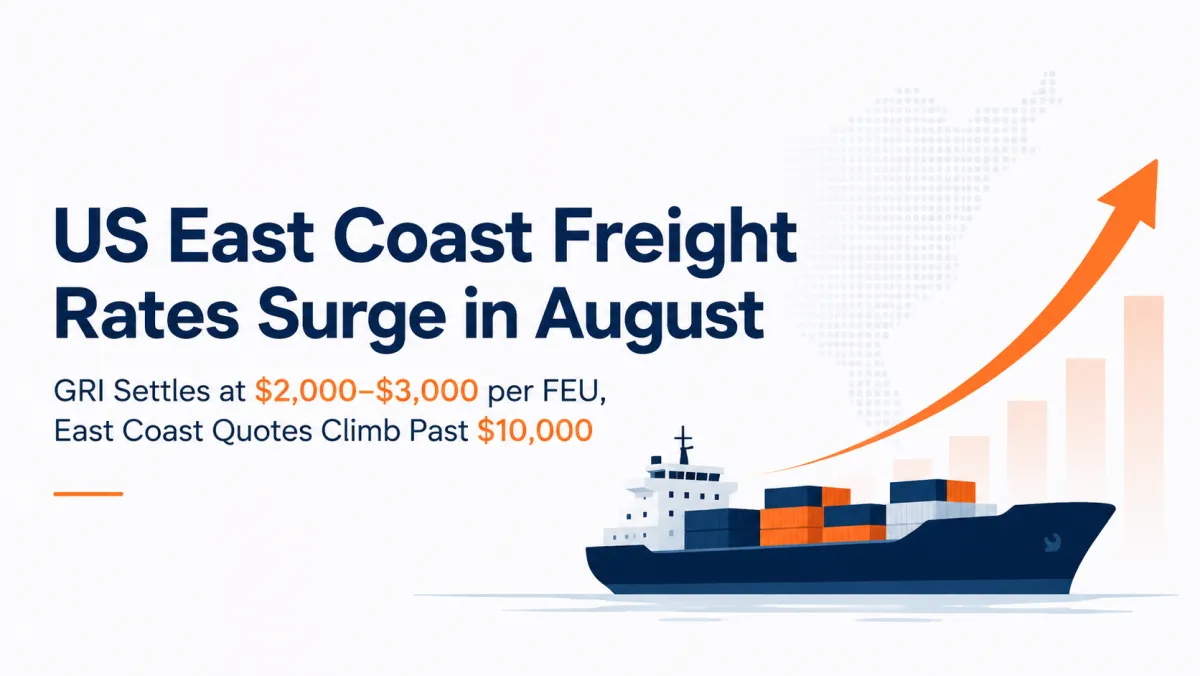
After three straight weekly declines, August GRIs flip the script on the transpacific
TL;DR: A new round of transpacific general rate increases (GRIs) took effect on August 1, with carriers raising rates by roughly $2,000-3,000 per FEU. Market reports say major carriers moved in step, pushing post-GRI USEC quotes past $10,000 per FEU and some USWC quotes above $9,000. On July 31 the SCFI composite closed at 3205.97, snapping three straight weekly declines with a 143.02-point jump (+4.67%), as quoted rates to both US coasts leapt about 12.5% in a single week — pricing in the hike before it landed. Actual spot transactions were still drifting lower into month-end: Drewry's WCI composite read $4,255 per FEU on July 30, down 3%. Whether the increases stick depends on August volumes, blank-sailing follow-through, and the peak-season clock. Europe issued rate-hike notices too — with visibly less support. Here are the key numbers and our August booking advice.
1) The reversal: SCFI rebounds 4.67% after three down weeks
After the SCFI ended its 10-week rally on July 10 at 3184.83, the index fell for three consecutive weeks to 3062.95 on July 24. Then came the turn: the July 31 reading from the Shanghai Shipping Exchange printed 3205.97, up 143.02 points or 4.67% week on week — recovering all of July's lost ground in one move.
Under the hood, this rebound was almost entirely a transpacific story: quoted rates from Shanghai to both the US West and East Coasts jumped about 12.5% on the week, while Europe and Mediterranean lanes still fell roughly 4% each. One caveat worth repeating: the SCFI records rates quoted for the coming week, and carriers make up about half of the respondent set — so the jump reflects carrier confidence in the August 1 GRI more than concluded deals.
At the transaction level, spot rates were still softening in July's final week: Drewry's World Container Index (WCI) composite came in at $4,255 per FEU on July 30, down 3% week on week, with Shanghai-Los Angeles at $5,739 per FEU (down 2%) and Shanghai-New York flat at $7,578 per FEU. US West Coast forwarder Freight Right's read: carriers deliberately let rates fall to stimulate demand and "bring pricing back to temporary market equilibrium" — the classic press-down-then-lift prelude to a GRI.
2) August 1 GRIs land: $2,000-3,000 per FEU, USEC aiming at five figures
From August 1, the transpacific saw its latest round of GRIs, ranging from about $2,000 to $3,000 per FEU depending on carrier. Working from pre-hike spot benchmarks: USEC on a $7,578 base lands in roughly the $9,600-10,600 per FEU range — so "USEC past $10,000" is no exaggeration — while USWC on a $5,739 base works out to about $7,700-8,700 per FEU. Market reports say major carriers raised in unison, with post-GRI USEC quotes breaking $10,000 per FEU and some USWC quotes pushed above $9,000.
Two reminders. First, a GRI is an announcement, not a settlement — the announced amount rarely equals the achieved amount, and final pricing follows space supply and demand. Second, August quotes often stack GRI and peak season surcharge (PSS): when comparing offers, confirm whether GRI/PSS are included, how long the quote is valid (peak-season spot quotes often run just 7-14 days), and whether space and equipment are guaranteed.
3) What's behind the push: blank sailings and capacity shuffling
This hike is not riding on paper alone. Drewry notes that with demand easing and earlier front-loading cooling off, carriers are managing capacity through blank sailings to stop further rate erosion: eight blanked sailings are scheduled on the transpacific for the first week of August, up from seven the week before.
The capacity-shuffling signal is just as clear: Chinese carrier BAL Container Lines cancelled a plan to deploy a one-off 14,000 TEU extra loader to the US West Coast, chartering the vessel to Maersk for Asia-Europe service instead — tightening USWC supply at the margin just as the GRI landed. On the demand side, with the tariff environment now clearer, US importers have kept shipping at a steady clip, giving carriers cover to hold the line.
4) The Europe contrast: same hike notices, far less support
Over the same window, Asia-Europe carriers issued August 1 increases of their own — and the market shrugged. Analysts at Linerlytica reported carriers offering below $5,000 per FEU on Asia-Europe, with "support for the 1 August rate hike quickly waning." The WCI told the same story: Shanghai-Rotterdam fell 3% to $4,677 per FEU and Shanghai-Genoa dropped 6% to $5,630, while the SCFI's Europe and Mediterranean legs each lost about 4%.
Capacity discipline is also thinner on Europe: three blank sailings are scheduled on Asia-Europe this week, down from four last week. Carriers are already lining up a second attempt — MSC has announced a new FAK level from August 15 of $7,800 per FEU for Asia-North Europe and $6,700 for Asia-Mediterranean. Same rate-hike letters, different odds: the transpacific has volume and capacity control behind it, Europe currently lacks the cargo support — one more case for reading rates trade by trade.
5) Will the increases stick? Three things to watch
Freight Right's framing is representative: if importers keep shipping steadily under the now-clearer tariff environment and volumes hold, carriers may maintain rates near current levels or modestly higher; if demand fails to strengthen, the market could settle back toward pre-hike pricing after a brief August spike. For a large-shipper perspective, LG Electronics expects ocean freight to peak in the third quarter and decline in the fourth.
We suggest exporters track three signals from here:
- A mid-August second push: whether carriers follow with another GRI/FAK round (MSC's Europe FAK is already set for August 15) is the key test of pricing power
- Blank-sailing follow-through: announcing cancellations is easy — actually blanking them is what counts; if August blankings keep scaling up, rate support gets real
- Volume cadence: back-to-school, year-end holiday restocking, and the pre-Golden Week shipping pulse will set September's direction
6) August booking advice
Given the current rhythm, we suggest layering bookings by schedule flexibility:
- Cargo that must ship in the next two weeks: with the GRI fresh and carriers most committed to holding it, negotiating room is thin — focus on space confirmation and cut-off times to avoid peak-season rollovers; still compare at least 2-3 carriers per lane, as spreads can exceed any discount you would win
- Flexible cargo: watch how the hike holds into mid-August — if volumes disappoint and quotes soften, ship in batches to average down; if a second round lands, lock forward space early
- Pin down the quote basis: GRI/PSS included or not, validity window, and whether space and equipment are guaranteed; a cheap quote without guaranteed space means little in peak season
- Extra attention on USEC via Panama: with El Niño concerns, the canal has begun tightening transit arrangements, and MSC and CMA CGM have announced Panama Canal surcharges — check surcharges and schedule risk on canal routings
- Contract vs. spot mix: how well this Q3 push holds will set the baseline for Q4 and next year's contract talks; keeping core volumes on contract and flexible volumes on spot still applies
7) Closing: the peak-season game enters its second half
July's slow drift and August's jump are two halves of the same peak-season play: carriers first discounted to keep cargo flowing, then lifted prices in a coordinated GRI-plus-blank-sailing move. With demand and capacity control both cooperating, the transpacific hike has a fair chance of holding near term — but forecasts like LG's "Q3 peak" are a reminder that chasing the top with long-term commitments carries its own risk. The mid-August second push and actual blank-sailing execution will give a much clearer directional signal.
[Follow-up] The "mid-August directional signal" this article pointed to has since resolved: transpacific rates went on a three-week run (Shanghai-New York at $9,507/FEU in the week of Aug 21), followed by high-level consolidation into September. For the latest numbers and booking advice, see "Transpacific rates up three straight weeks: Shanghai-East Coast breaks $9,500, Panama Canal surcharges loom in September" (last updated August 28, 2026).
If you need USWC/USEC ocean export bookings, multi-carrier rate comparison, or help balancing contract and spot exposure, contact Mighty International — we can build a steadier space-and-cost plan around your volume cadence and delivery deadlines.